Rusalka op. 114

$60.13

Catalog No.:

TP00438

Subtitle:

Lyric Fairy Tale in Three Acts

Composer:

Dvorak, Antonin

Arranger:


Editor:

Simon, Robert / Hájek, Jonáš

Series:


Publisher:

Bärenreiter

Format:

Study score, Urtext edition

Pages:


Language:

EN

Description

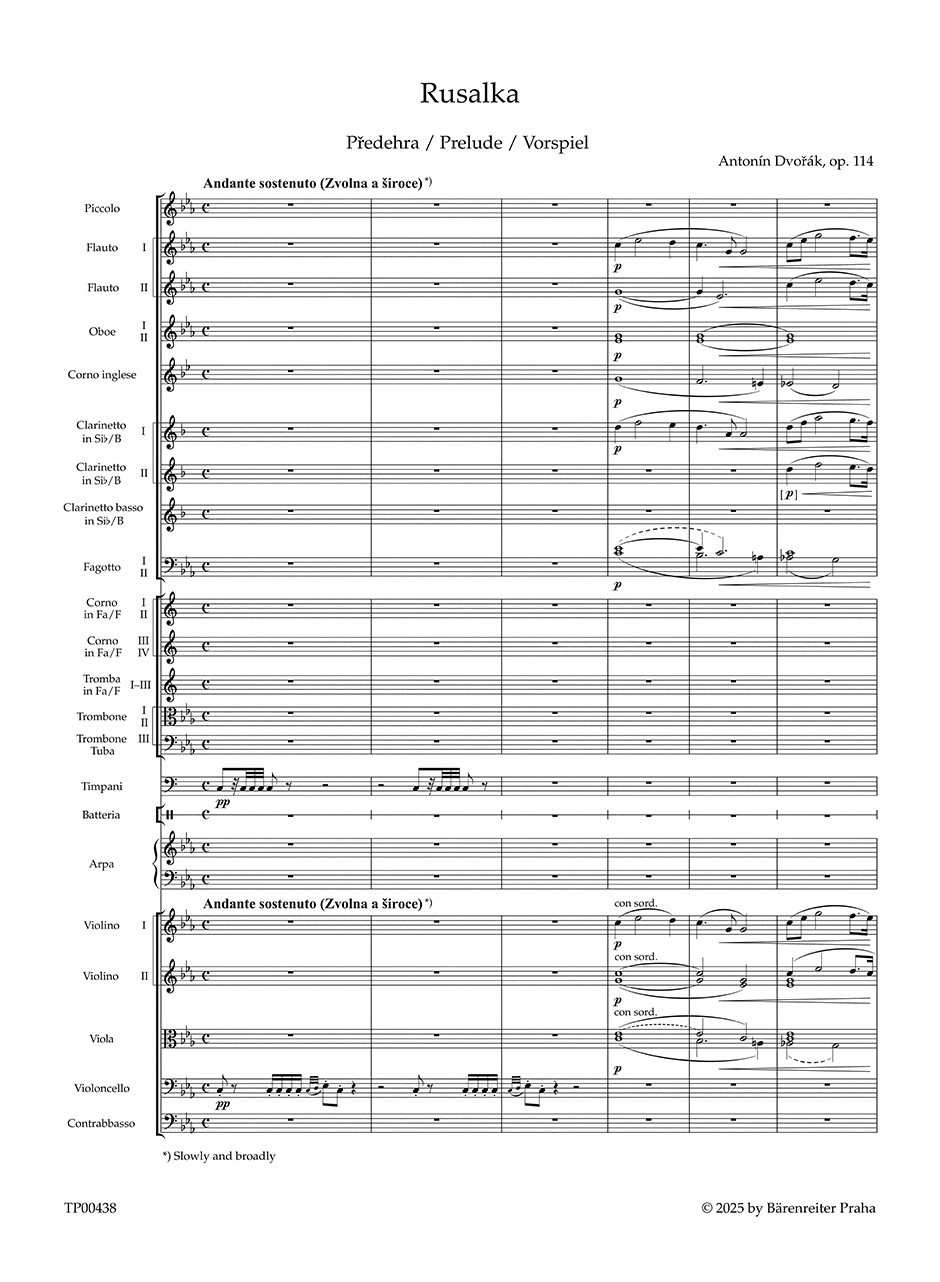
This study score of Antonín Dvorák’s penultimate and most well-known opera “Rusalka” (1900) corresponds to the new critical edition published in 2023 that brings the musical text of the opera up to today’s standards. Editors Robert Simon and Jonáš Hájek worked not only with the autograph and the copy of the score from which the premiere and many subsequent performances were conducted, but also with three handwritten piano reductions directly connected to Dvorák that had not been evaluated for the previous Jarmil Burghauser edition, as well as with sketches and other sources. What is new compared to the previous edition is the consistent marking of editorial additions, the restoring of some of Dvorák’s original readings in the vocal text, and a detailed evaluation of the vi-de markings authorised by the composer. At the same time a certain variability is retained and conductors continue to have the option to make cuts.
Rusalka op. 114

$672.00

Catalog No.:

BA10438

Subtitle:

Lyric Fairy Tale in Three Acts

Composer:

Dvorak, Antonin

Arranger:


Editor:

Simon, Robert / Hájek, Jonáš

Series:


Publisher:

Bärenreiter

Format:

Score, Urtext edition

Pages:


Language:

EN

Description

Antonín Dvorák composed his penultimate and most well-known opera “Rusalka” in just seven months between April and November 1900. The premiere took place on 31 March 1901 at the National Theatre in Prague under Karel Kovarovic. Today, “Rusalka” is one of the most frequently performed works of the international opera scene.

More than sixty years after the Jarmil Burghauser edition, a new critical edition is presented here that brings the musical text of the opera up to today’s standards. Editors Robert Simon and Jonáš Hájek worked not only with the autograph and the copy of the score from which the premiere and many subsequent performances were conducted, but also with three handwritten piano reductions directly connected to Dvorák, but unknown to Burghauser, as well as with sketches and other sources. What is new compared to the previous edition is the consistent marking of editorial additions, the restoring of some of Dvorák’s original readings in the vocal text, and a detailed evaluation of the vi-de markings authorised by the composer. At the same time variability is retained and conductors continue to have the option to make cuts.
The pronunciation guide under Multimedia was recorded by Martin Vodrážka.

Rusalka op. 114

$82.60

Catalog No.:

BA10438-90

Subtitle:

Lyric Fairy Tale in Three Acts

Composer:

Dvorak, Antonin

Arranger:

Koronthály, Petr

Editor:

Simon, Robert / Hájek, Jonáš

Series:


Publisher:

Bärenreiter

Format:

Vocal Score, Urtext edition

Pages:


Language:

EN

Description

Antonín Dvorák composed his penultimate and most well-known opera “Rusalka” in just seven months between April and November 1900. The premiere took place on 31 March 1901 at the National Theatre in Prague under Karel Kovarovic. Today, “Rusalka” is one of the most frequently performed works of the international opera scene.

More than sixty years after the Jarmil Burghauser edition, a new critical edition is presented here that brings the musical text of the opera up to today’s standards. Editors Robert Simon and Jonáš Hájek worked not only with the autograph and the copy of the score from which the premiere and many subsequent performances were conducted, but also with three handwritten piano reductions directly connected to Dvorák, but unknown to Burghauser, as well as with sketches and other sources. What is new compared to the previous edition is the consistent marking of editorial additions, the restoring of some of Dvorák’s original readings in the vocal text, and a detailed evaluation of the vi-de markings authorised by the composer. At the same time variability is retained and conductors continue to have the option to make cuts.
The vocal score was issued by the publisher Mojmír Urbánek only after Dvorák’s death in 1905. This is why Burghauser did not consider it relevant. In fact, however, the composer had taken part in the preparation of the piano reduction and had given it his very own sound character by taking the liberty of deviating here and there from the full score. This excellent, well-manageable piano part was largely adopted in the new piano reduction by Petr Koronthály. Also included are notes by the American soprano Bree Nichols on the pronunciation of the Czech vocal text.

The pronunciation guide under Multimedia was recorded by Martin Vodrážka.